Journey to the center of the earth
Ever wondered what our earth is made of? Think of it as an apple. An apple constitutes the skin, the pulp and the core in the middle. Similarly, the earth is made up of the thin outermost layer called the crust, the
innermost part called the core, and the part in between them called the mantle.

The outer most layer is crust which classified in to two parts
The continental crust is the layer of igneous, sedimentary, and metamorphic rocks which forms the continents the areas of shallow seabed close to their shores, known as continental shelves
Consisting mostly of granitic rock, continental crust has a density of about 2.7 g/cm3 and is less dense than the material of the Earth's mantle (density of about 3.3 g/cm3), which consists of mafic rock. Continental crust is also less dense than oceanic crust (density of about 2.9 g/cm3), though it is considerably thicker; mostly 25 to 70 km versus the average oceanic thickness of around 7–10 km. About 40% of the Earth's surface is now overlaid by continental crust. Continental crust makes up about 70% of the volume of Earth's crust.
 |
| A contour map of the thickness of the Earth's crust (numbers in kilometres) |
Oceanic crust is the part of Earth's lithosphere that surfaces in the ocean basins. Oceanic crust is primarily composed of mafic rocks, or sima, which is rich in iron and magnesium. It is thinner than continental crust, or sial, generally less than 10 kilometers thick, however it is denser, having a mean density of about 2.9 grams per cubic centimeter as opposed to Continental which has a density of about 2.7 grams per cubic centimeter.
Oceanic crust :is significantly simpler than continental crust and generally can be divided in three layers.
Layer 1: is on an average 0.4 km thick. It consists of unconsolidated or semiconsolidated sediments, usually thin or even not present near the mid-ocean ridges but thickens farther away from the ridge. Near the continental margins sediment is terrigenous, meaning derived from the land, unlike deep sea sediments which are made of tiny shells of marine organisms, usually calcareous and siliceous, or it can be made of volcanic ash and terrigenous sediments transported by turbidity currents.
Layer 2: could be divided into two parts: layer 2A – 0.5 km thick uppermost volcanic layer of glassy to finely crystalline basalt usually in the form of pillow basalt, and layer 2B – 1.5 km thick layer composed of diabase dikes.
Layer 3 : is formed by slow cooling of magma beneath the surface and consists of coarse grained gabbros and cumulate ultramafic rocks. It constitutes over two-thirds of oceanic crust volume with almost 5 km thickness
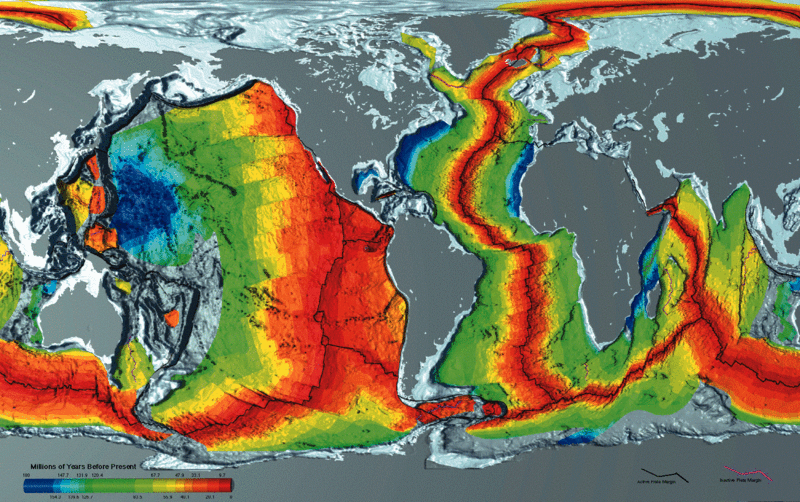 |
| Age of oceanic crust. The red is most recent, and blue is the oldest. |
The mantle
is the layer located directly under the sima. It is the largest layer of the Earth, 1800 miles thick. The mantle is composed of very hot, dense rock. This layer of rock even flows like asphalt under a heavy weight. This flow is due to great temperature differences from the bottom to the top of the mantle. The movement of the mantle is the reason that the plates of the Earth move
Two main zones are distinguished in the upper mantle: the inner asthenosphere composed of plastic flowing rock about 200 km thick, and the lowermost part of the lithosphere composed of rigid rock about 50 to 120 km thick.A thin crust, the upper part of the lithosphere, surrounds the mantle and is about 5 to 75 km thick.
In the mantle, temperatures range between 500 to 900 °C (932 to 1,652 °F) at the upper boundary with the crust; to over 4,000 °C (7,230 °F) at the boundary with the core.
Although the higher temperatures far exceed the melting points of the mantle rocks at the surface (about 1200 °C for representative peridotite), the mantle is almost exclusively solid. The enormous lithostatic pressure exerted on the mantle prevents melting, because the temperature at which melting begins (the solidus) increases with pressure
The core
Lying more than 5,000km beneath our feet, at the centre of the Earth, the core is beyond
the reach of direct investigation. it consists of a solid sphere of metal sitting within a liquid outer core.
The outer: core of the Earth is a liquid layer about 2,266 km (1,408 mi) thick composed of iron and nickel which lies above the Earth's solid inner core and below its mantle. Its outer boundary lies 2,890 km (1,800 mi) beneath the Earth's surface. The transition between the inner core and outer core is located approximately 5,150 km (3,200 mi) beneath the Earth's surface.The temperature of the outer core reach to 4400 °C,8000 °F
The inner core: of the Earth, its innermost part, is a primarily solid ball with a radius of about 1,220 km (760 mi), according to seismological studies. (This is about 70% of the length of the Moon's radius.) It is believed to consist primarily of an iron–nickel alloy, and to be about the same temperature as the surface of the Sun: approximately 5700 K (5430 °C.
Two main zones are distinguished in the upper mantle: the inner asthenosphere composed of plastic flowing rock about 200 km thick, and the lowermost part of the lithosphere composed of rigid rock about 50 to 120 km thick.A thin crust, the upper part of the lithosphere, surrounds the mantle and is about 5 to 75 km thick.
In the mantle, temperatures range between 500 to 900 °C (932 to 1,652 °F) at the upper boundary with the crust; to over 4,000 °C (7,230 °F) at the boundary with the core.
Although the higher temperatures far exceed the melting points of the mantle rocks at the surface (about 1200 °C for representative peridotite), the mantle is almost exclusively solid. The enormous lithostatic pressure exerted on the mantle prevents melting, because the temperature at which melting begins (the solidus) increases with pressure
 |
| Earth's mantle |
Lying more than 5,000km beneath our feet, at the centre of the Earth, the core is beyond
the reach of direct investigation. it consists of a solid sphere of metal sitting within a liquid outer core.
The outer: core of the Earth is a liquid layer about 2,266 km (1,408 mi) thick composed of iron and nickel which lies above the Earth's solid inner core and below its mantle. Its outer boundary lies 2,890 km (1,800 mi) beneath the Earth's surface. The transition between the inner core and outer core is located approximately 5,150 km (3,200 mi) beneath the Earth's surface.The temperature of the outer core reach to 4400 °C,8000 °F
The inner core: of the Earth, its innermost part, is a primarily solid ball with a radius of about 1,220 km (760 mi), according to seismological studies. (This is about 70% of the length of the Moon's radius.) It is believed to consist primarily of an iron–nickel alloy, and to be about the same temperature as the surface of the Sun: approximately 5700 K (5430 °C.


